


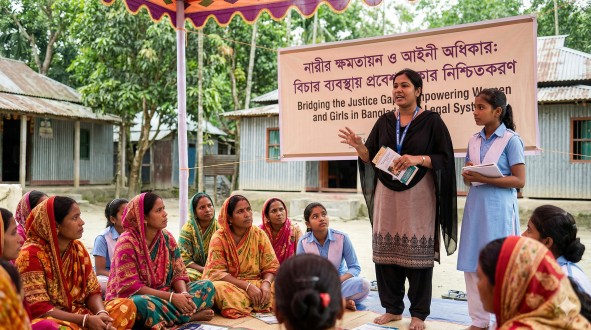
As the world observes International Women’s Day on the 8th of March 2026, the resonance of this year’s theme, "Rights. Justice. Action. For ALL Women and Girls," strikes a particularly urgent chord within the legal and social framework of Bangladesh. This theme is not merely a global slogan; it is a profound indictment of the local status quo, demanding that we bridge the treacherous gap between the rights that exist on paper and the justice that is actually delivered in our courtrooms and communities. The foundation of women’s rights in Bangladesh is robustly enshrined in the Constitution of the People's Republic of Bangladesh, enacted in 1972, which boldly promises equality and non-discrimination. Article 27 guarantees equality before the law and equal protection of the law, while Article 28 explicitly prohibits discrimination on the grounds of sex, asserting that women shall have equal rights with men in all spheres of the state and public life. Furthermore, Article 28(4) empowers the state to make special provisions in favor of women and children, recognizing the historical and systemic disadvantages they face. Articles 10 and 19 additionally mandate the state to ensure women's participation in national life and eliminate socio-economic inequalities between men and women. These progressive constitutional provisions align with Bangladesh's international commitments, notably the ratification of the Convention on the Elimination of All Forms of Discrimination Against Women (CEDAW) in 1984, though reservations on certain articles have historically limited its full implementation. Despite these robust frameworks, the lived reality of millions of Bangladeshi women stands in stark, often tragic, contrast to these constitutional guarantees. The dichotomy between progressive constitutional aspirations and regressive social realities dictates that rights are practically meaningless without a functional, accessible, and empathetic justice delivery mechanism. The emphasis on "Action" this year is a critical pivot from passive celebration to active, systemic reform, urging the nation to dismantle structural barriers and discriminatory practices.
To understand the sheer magnitude of this challenge, society must confront the staggering statistical reality that defines the daily lives of women across the country. According to the recent Violence Against Women survey conducted by the Bangladesh Bureau of Statistics in collaboration with UNFPA, an alarming 70 to 76 percent of women have experienced at least one form of intimate partner violence whether physical, sexual, emotional, or economic in their lifetime. Even more distressing is the finding that nearly half of these women have faced such violence within the last twelve months. These horrifying figures are heavily corroborated by law enforcement records; Police Headquarters data reveals a sharp surge in violence against women, escalating from 5,795 cases in the last four months of 2024 to 7,028 in the first four months of 2025, with sexual violence climbing even further. In 2025 alone, the Bangladesh Mahila Parishad documented 786 rape and gang-rape victims, representing a 52 percent increase from prior years, which tragically included 543 girls under the age of 18. Furthermore, the Human Rights Support Society (HRSS) reported 6,305 rapes between 2020 and 2024, noting that 55 percent involved minors, alongside 207 murders following assaults. Independent human rights organizations like Ain o Salish Kendra also continuously report horrific numbers regarding domestic violence, rape, dowry-related deaths, and acid attacks year after year. These statistics are not merely abstract data points; they represent a catastrophic failure of preventative mechanisms and a chilling indictment of a society where the home frequently remains one of the most dangerous places for a woman.
The vulnerability of women and girls is further compounded by intersecting rights violations, most notably the persistent crisis of child marriage. Bangladesh currently holds the highest rate in Asia and the eighth highest globally, with 51.4 percent of women aged 20 to 24 having been married before the age of 18. This widespread practice continues despite the Prevention of Child Marriage Act of 2017 legally setting 18 as the minimum age for marriage. Rooted deeply in poverty and patriarchal norms, this practice leads to severe health risks, massive school dropout rates, and intergenerational cycles of inequality. The law's enforcement remains alarmingly weak, with loopholes such as Special Marriage provisions frequently exploited in rural areas. The horrific consequences of this vulnerability are reflected in recent data showing 306 child rapes in just the period of January to July 2025 alone, a 75 percent increase from the previous year. Similarly, dowry-related violence, which was criminalized through the Dowry Prohibition Act in 1980, continues to claim hundreds of lives annually. Historical data from 2006 to 2012 logged thousands of brutal incidents, including 325 murders in a single year, contributing to 66.7 percent of all violence against women. These fatal patterns persist into recent years amid rising demands. Acid attacks also still occur, despite the Acid Crime Control Act of 2002 significantly reducing their frequency, highlighting the incomplete nature of legal deterrence.
In response to this endemic violence, Bangladesh has enacted a critical pillar of specialized legislation designed to protect women and punish offenders. The Nari O Shishu Nirjatan Daman Ain (Prevention of Women and Children Repression Act), originally enacted in 2000 and amended in 2020, imposes stringent penalties, including the death penalty and life imprisonment, for heinous crimes such as rape, acid throwing, and dowry-related violence. This act also mandates DNA testing for evidence collection and the establishment of specialized tribunals to expedite trials. Complementing this, the Domestic Violence (Prevention and Protection) Act of 2010 was initially hailed as a watershed moment, legally defining physical, psychological, emotional, and economic abuse within the household. It provided crucial civil mechanisms, empowering courts to issue protection orders, residence rights, and compensation, shifting the focus from mere criminal penalization to the immediate safety and financial stability of the survivor. Yet, over a quarter of a century after the passage of foundational laws, the efficacy of this legal arsenal is severely compromised by a painfully low conviction rate, exposing massive systemic justice deficits. The conviction rate hovers at a dismal 3 to 4 percent for cases of violence against women, according to tribunal data from multiple districts, with BRAC studies reviewing 385 specific court cases revealing that only 3.6 percent resulted in convictions. The reasons for this profound failure are manifold: flawed and delayed police investigations, a severe lack of forensic capacity, out-of-court settlements coerced through local intimidation, and a heavily burdened judicial process. Low reporting, driven by intense stigma, family pressure, and pervasive victim-blaming, compounds this crisis. Because the certainty of punishment is incredibly low, stringent legislation fails to act as a deterrent, proving that laws without robust, survivor-centric enforcement are fundamentally hollow. Furthermore, the utilization of civil remedies like the 2010 Domestic Violence Act remains dismally low, as societal conditioning normalizes abuse as a private family matter and enforcement agencies frequently advise survivors to compromise and return to highly abusive environments.
The harrowing journey of a survivor through the traditional criminal justice system often constitutes a devastating secondary form of trauma, highlighting the immediate need for comprehensive procedural reforms. From the very moment a woman steps into a local police station to file a First Information Report, she is frequently met with skepticism, intense moral policing, and bureaucratic apathy. Medical examination procedures for sexual assault survivors have historically been archaic, invasive, and degrading, and while high court directives have sought to modernize them, grassroots implementation remains frustratingly inconsistent.To achieve true justice, Bangladesh must urgently adopt a strictly survivor-centric approach that includes mandatory in-camera trials, robust witness protection programs, and the unyielding enforcement of evidence laws prohibiting defense attorneys from questioning a survivor's general immoral character. Furthermore, Bangladesh must prioritize fast-track courts for women-related cases, piloted under the 2020 amendments, enforcing mandatory timelines such as concluding trials within three years for divorce and violence cases. Specialized, continuous training for judges, prosecutors, and police personnel on gender sensitivity is absolutely crucial. Community legal aid, expanded via prominent NGOs like BRAC, must also empower survivors to report abuses without fear.
Perhaps the most crippling structural barrier to justice is the agonizing delay in the disposal of cases. Courts are suffocating under a massive backlog of millions of pending cases. In the context of violence against women, justice delayed is an active enabler of total impunity; as years pass, vital evidence degrades, witnesses relocate or forget, and accused individuals out on bail relentlessly intimidate survivors into withdrawing cases. The immense psychological and financial toll forces many women to abandon their pursuit of justice altogether.. By digitalizing Bangladesh legal decisions and building intelligent databases, lawyers can retrieve case laws instantly and build unassailable cases in a fraction of the time, translating to substantially faster trials and vastly better representation. However, as the legal sector integrates artificial intelligence, it must remain fiercely vigilant to ensure algorithms which learn from decades of patriarchal jurisprudence are deliberately designed to promote equity. Redesigning AI for gender parity and actively auditing legal databases to prevent the marginalization of gender-based violence cases is a critical imperative.
The proliferation of smartphones has brought an avalanche of online harassment, cyberstalking, non-consensual sharing of intimate images, and sexual blackmail. Government surveys indicate a significant percentage of women with internet access have faced cyber violence, a number undeniably underreported due to intense social stigma. While the Cyber Security Ordinance of 2025 exists to penalize digital offenses, law enforcement officers often lack the specialized technical training to investigate cybercrimes effectively and empathetically. Combating this modern frontier requires proactive action beginning long before a crime occurs. Society must foster a culture of digital literacy, consent, and mutual respect by conducting targeted awareness sessions in primary and secondary schools, equipping the next generation to protect themselves and respect others online. Education is undeniably the most potent preventative weapon in eradicating the roots of gender-based violence in the modern digital age.
Economic empowerment is intrinsically linked to justice, making the strict enforcement of workplace rights highly critical. Economic justice severely lags in Bangladesh, characterized by a persistent gender wage gap of 21 to 30 percent, which reaches 23.1 percent when factoring in the intense segregation of women into low-paid sectors like the garments industry. While national labor laws theoretically mandate paid maternity leave, actual compliance particularly among marginalized domestic workers is shockingly low and rarely monitored. To address this, international partnerships must bolster capacity; Bangladesh needs to ratify ILO Conventions 189 and 190 to protect domestic workers and enforce anti-harassment protocols. Furthermore, the glaring absence of a comprehensive statutory law addressing sexual harassment in the workplace leaves millions vulnerable to daily exploitation. Although landmark High Court guidelines from 2009 directed institutions to form internal complaint committees, enforcement relies heavily on fragile institutional goodwill rather than strict legal mandates. The legislature must urgently draft and pass a standalone law against sexual harassment covering all workplaces, educational institutions, and public spaces.
Beyond the workplace, the fight for equal rights must directly confront deeply entrenched inequalities within the personal laws governing marriage, divorce, maintenance, and inheritance. Varying by religion, these laws consistently place women at a severe economic and social disadvantage. The glaring disparity in inheritance rights systematically deprives women of vital capital; under current personal laws, Muslim women generally receive only half of the shares allocated to male heirs, while Hindu women often receive none. This state-sanctioned economic vulnerability traps countless women in abusive marriages, completely limiting their financial ability to seek justice or live independently. The Women's Affairs Reforms Commission, which submitted a report in April 2025 containing 433 recommendations, powerfully addresses this issue. The Commission calls for constitutional amendments to excise discriminatory provisions, the withdrawal of CEDAW reservations, and crucially, a uniform family code ensuring equal rights across all religions. A uniform family code would standardize rights, enabling women to confer citizenship on foreign spouses and securely maintain land ownership. The Commission further advocates strengthening the 2010 Domestic Violence Act with harsher penalties, establishing victim-witness protection laws, introducing gender-responsive budgeting, equal pay legislation, and forming a permanent Women's Commission for oversight.
The realization of these ambitious reforms and a truly gender-just legal system requires significant political will and the active mobilization of all sectors of society. Unfortunately, political representation for women hit a historic low in the 2026 elections, even when factoring in mandatory quotas, alongside a mere seven directly elected female MPs. This severe underrepresentation drastically undermines legislative advocacy for essential gender reforms. The interim government's 2025 reforms, now transitioning under the new administration, offer momentum, but political will is key, starting with elevating the Women and Children Affairs Ministry under a full-time female minister. Simultaneously, the legal community must step up as ultimate gatekeepers to the justice system, bearing a profound moral obligation to advocate relentlessly. This means proactively taking up pro bono cases for indigent women, aggressively challenging discriminatory laws through public interest litigations, and holding law enforcement accountable. The legal fraternity must rapidly transition into fierce architects of social justice.
As the world marks International Women's Day 2026, the theme must serve as a definitive, actionable blueprint for the future. Bangladesh can no longer afford a legal system that guarantees rights in theory but consistently denies them in practice through crippling procedural delays and systemic patriarchal biases. The call to action is abundantly clear: enforce existing laws with unyielding determination, modernize legal processes through comprehensive digitalization, enact the Reforms Commission's vital blueprint, and educate communities at the grassroots level. Society must collectively build a justice system that is no longer a source of fear for survivors, but a genuine beacon of hope and absolute accountability. Only through relentless, collective action can the nation permanently dismantle structural barriers to equality and ensure that true, unfiltered justice becomes the lived reality for every single woman and girl in Bangladesh.
by
kazi Noor E Zannat



No comments yet. Be the first to share your thoughts!